- Home
- Living Gluten Free
- Gluten-Free Skin Care
Do You Need Gluten-Free Skin Care if You Have Celiac Disease?
Last updated: March 2026
If you’re new to celiac disease, you’ve likely focused on your diet. But you may also be thinking about skin care products.
Are you wondering if you need gluten-free cosmetics, shampoo, or lotions?
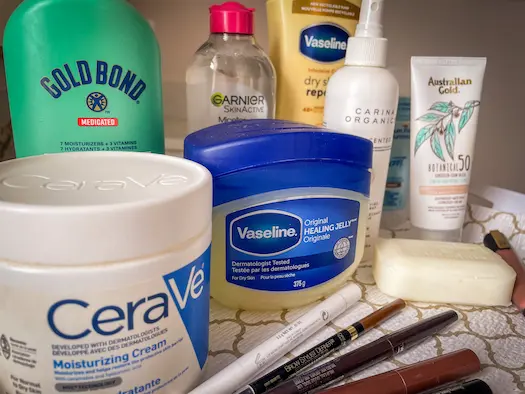
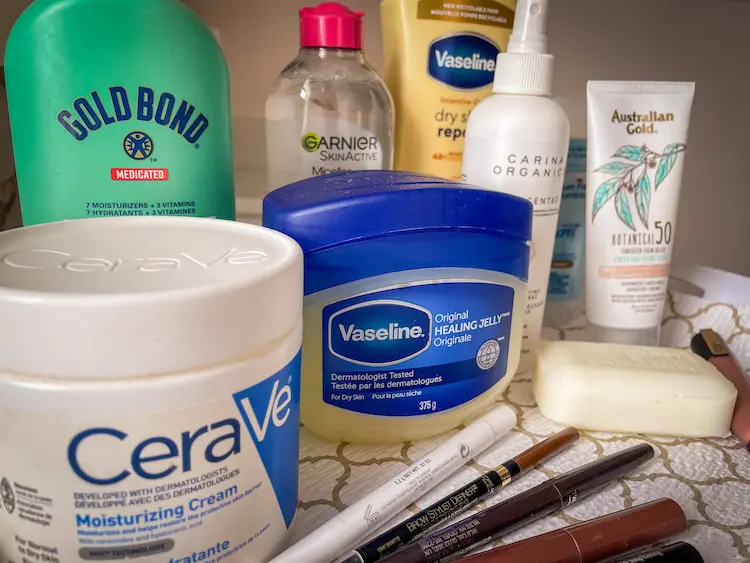
This is a reasonable question, and one that many people with celiac disease are concerned about. The good news is – the answer is no. Gluten is not absorbed through the skin. Celiac reactions occur when gluten is ingested and reaches the small intestine.1
Yet some people, myself included, choose to avoid gluten in skin care. With that in mind, let’s explore the facts so you can make your own decisions.
On This Page:
There is a lot of info here. You can scroll through or use the links below to go to the section that interests you.
4 Simple Recommendations for Healthier Skin and Better Balance
Plus: Thoroughly researched information about:
Dermatitis Herpetiformis and Other Causes of Itchy, Sensitive Skin.
Gluten-free Diet and Skin Improvement – my own experience and what the science says.
Gluten-free Skin Care products – What’s in them, how find them, and what I use.
Gluten-Free Skin Care: 4 Common Questions Answered
How gluten affects your skin and whether gluten-free skin care products are necessary is a confusing topic. Despite reassurance from various celiac associations, people on celiac forums often report that they react to gluten in skin-care products.
So, let’s explore the most common questions, review what the experts say, and draw our conclusions together.
 |
Want simple guidance, trusted resources, and doable recipes delivered to your inbox once a week? |
|
Question 1. Can Gluten Be Absorbed Through the Skin?
No, and here's why - gluten is a protein molecule that is too large to pass through the skin barrier. The outer layer of skin (the stratum corneum) prevents most substances from entering the body. Only very small molecules can cross this barrier.1
Question 2. Can Gluten in Skin Care Products Cause Celiac Symptoms?
No. The celiac reaction is autoimmune and happens in the small intestine. To cause a celiac reaction gluten must be ingested and reach the small intestine. This does not happen when you apply gluten to your skin.2
Question 3. Can Gluten in Skin Care Products Cause Breakouts?
Research suggests the gluten protein does not cause breakouts or irritation through skin contact.
If you react to a cosmetic product, the cause may be a wheat allergy or a sensitivity to another ingredient. A dermatologist or allergist can help identify the trigger.3
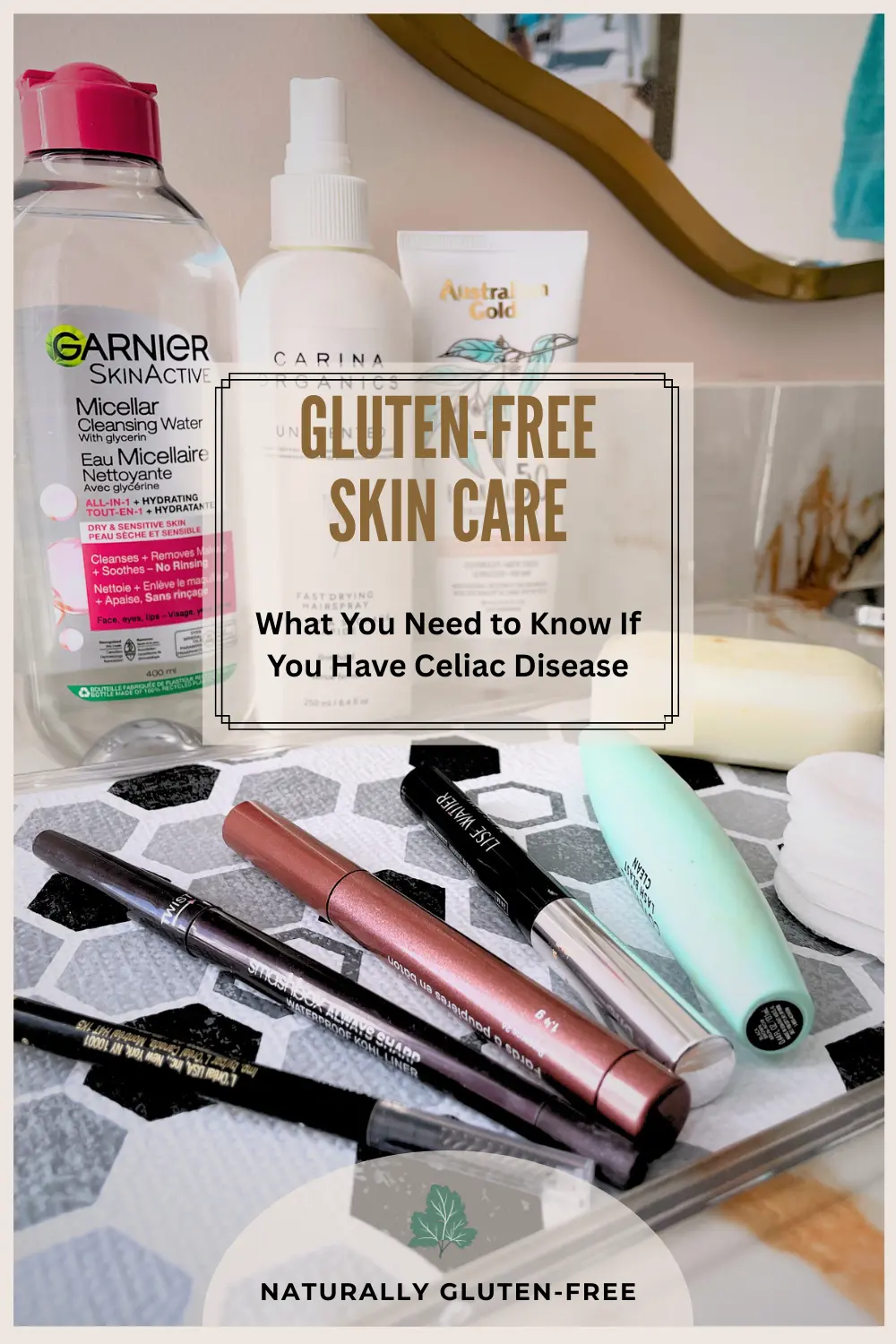
Question 4. Should a Person with Celiac Disease Avoid Skin Care Products That Contain Gluten?
It’s a personal choice.
Several expert organizations have examined whether gluten in cosmetics poses a risk to people with celiac disease.
- A 2019 Italian study tested 66 cosmetic products and found gluten levels to be non-existent or extremely low — well below the 20 ppm considered safe for gluten-free foods.4
- The Canadian Celiac Association concludes that even if small amounts of gluten were present, the amount accidentally ingested from cosmetics would be negligible.5
- The Mayo Clinic and the Celiac Disease Foundation also state that gluten cannot be absorbed through the skin.6
Some organizations still recommend choosing gluten-free lip products or being cautious with active DH flares. This may seem confusing, but their caution acknowledges that research is ongoing.
Gluten-Free Skin Care - 4 Simple Recommendations
- Stick to your healthy, naturally gluten-free diet. That is the best thing you can do for your skin.
- If you have sensitive skin and react to certain products, check with a dermatologist or allergist and see what the issue is. You may be allergic to wheat, or to some other ingredient.
- Get your thyroid checked. More on this below.
- Do what makes you feel good, calm and safe. If you don’t like the idea of having gluten in your skin care products and you prefer to avoid it, that’s okay.
That’s the approach I take. I put so much effort into avoiding gluten in my diet, putting it on my skin or my lips doesn’t make sense to me. Gluten-free products are available and that’s what I choose. I also take comfort knowing that if I mess up, it’s not a big deal.
Celiac Disease and Itchy Sensitive Skin
Dermatitis Herpetiformis (DH)
We've established that applying gluten to your skin won’t cause a celiac reaction. But consuming gluten can affect your skin if you have celiac disease. The condition is called dermatitis herpetiformis or DH for short. It is an autoimmune reaction to ingesting gluten and is sometimes described as "celiac disease of the skin."
Celiac disease can show up in many ways. Some people have digestive symptoms like stomach pain, diarrhea etc. Others have brain fog or achy joints. For some people with celiac disease, DH is the only sign. For me, it was the first overt symptom I experienced and my doctor didn't even recognize it. My DH was misdiagnosed as contact dermatitis — it would be 22 years before I received a celiac diagnosis.
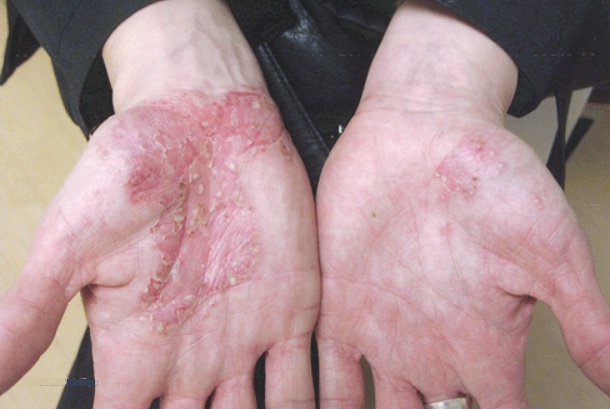
DH appears as tiny fluid-filled blisters that may or may not develop a white head. They are extremely itchy, especially if the blister breaks. The rash is usually symmetrical, appearing in the same place on both sides of the body — often on the elbows, knees, or buttocks. In my case it showed up on the palms of my hands. The flare-ups were uncomfortable and embarrassing. I could see cashiers glance at my hands when I handed them money, and shaking hands was out of the question.
Dermatitis herpetiformis is the skin manifestation of celiac disease and is sometimes the only symptom. It is caused by ingesting gluten, not by anything you put on your skin. The only cure is a gluten-free diet.
What To Do if Your Get a DH Flare
As unpleasant as it is, your dermatitis herpetiformis may flare up occasionally. Here are a few tips to manage it:
- avoid scented products
- don't scratch
- moisturize
- use hydrocortisone cream sparingly and not on open sores
- maintain your gluten-free diet
- examine your diet over the last few days for accidental gluten exposure.
Other Causes of Itchy Sensitive Skin
Many people with celiac disease, myself included, report having very sensitive skin. For example, they can't use scented products, harsh cleaners, certain laundry detergents or hair-care products. We don't yet have a clear explanation of the link between celiac and sensitive skin, but here are two possibilities:
- People with celiac disease often have other food intolerances. Perhaps people with DH are prone to other skin sensitivities.
- Autoimmune diseases tend to cluster. Autoimmune thyroid disease, which often occurs alongside celiac disease, can cause itchy, sensitive skin. So you may want to get your thyroid checked.
I was surprised to learn about the link between Hashimoto's Thyroiditis and food intolerance. If you recognize yourself in this article, consider getting your thyroid checked.

Gluten-Free Diet and Skin Improvement
We've talked about dermatitis herpetiformis (DH), but what about the “normal” breakouts —the little annoyances that come along from day to day?
There is limited scientific evidence that gluten causes acne or other skin conditions, yet many people who have removed gluten from their diets report improvement to their skin.
My Experience with Skin Improvement After Going Gluten-Free
Breakouts
I've always had sensitive skin. For as long as I can remember I’ve been susceptible to breakouts. Pimples would pop up regularly, though nothing I couldn’t cover up with a bit of makeup. Then once a month I would get a large painful blemish under the skin that I could do nothing with but accept. I also had breakouts on my back and shoulders. Every so often I’d scratch without thinking and end up bleeding.
Sensitivity
Any contact with household cleaners or soaps would have my hands breaking out in itchy blisters. Winter was a skin nightmare. No matter how much I’d moisturize, I’d always be tearing at my skin, the itchiness driving me nuts. Cortisone creams and itch creams would help, but you can only do that so much.
Skin Improvement
Since going gluten-free, you’d think I’d traded in my old skin for an upgrade. I rarely get a pimple. If I do get a blemish, it’s tiny and easy to take care of. I wear very little makeup these days. It’s not necessary. The redness is gone from my skin. The pores and little veins have shrunk to being barely noticeable. No more breakouts on my back.
Ongoing Challenges
I still get dry skin in the winter, but it’s easily dealt with by moisturizing and a little hydrocortisone. My skin even feels different. When I’d rub my face I used to feel all the little bumps forming under the surface. Now it feels smooth and soft.
I am still sensitive to scented products and harsh detergents so going gluten-free hasn't resolved all my skin problems, but it's certainly made them more manageable.
Gluten-Free Skin Care Products
If you have celiac, it is up to you to decide what is important based on your own comfort level.
You may decide that what you put on your skin is only important if it's likely it is to end up in your mouth. For me, I work hard to keep gluten out of my life and so I opt for gluten-free skin care as well.
In this section we’ll cover:
- common skin care ingredients that may or do contain gluten
- how to find gluten-free skin care products
- a few of my personal brand recommendations / reviews
Skin Care Ingredients That Contain Gluten
Here's a list of common skin care ingredients that may or do contain gluten as well as a few that sound scary but are actually safe:
Ingredients That Contain Gluten
These ingredients are derived from wheat, rye, or barley and contain gluten proteins.
- Hydrolyzed Wheat Flour
- Hydrolyzed Wheat Gluten
- Hydrolyzed Wheat Protein
- Hydrolyzed Wheat Protein/PVP Crosspolymer
- Hydrolyzed Wheat Starch
- Triticum Vulgare (Wheat) Germ Extract
- Triticum Vulgare (Wheat) Germ Oil
- Triticum Vulgare (Wheat) Gluten
- Triticum Vulgare (Wheat) Starch
- Wheat Amino Acids
- Wheat Germ Glycerides
- Wheat Germamidopropalkonium Chloride
- Wheatgermamidopropyl Ethyldimonium Ethosulfate
- Wheat Protein
- Secale Cereale (Rye) Seed Flour
- These are straightforward to identify because the grain source is listed directly.
Ingredients That May Be Derived from Gluten
These ingredients can be produced from wheat, barley, or rye, but are often made from corn, potato, or tapioca instead. When the source is unclear, you may wish to verify with the manufacturer.
- Dextrin
- Dextrin Palmitate
- Maltodextrin
- Hydrolyzed Vegetable Protein
- Hydrolyzed Malt Extract
Ingredients That Sound Concerning but Are Usually Gluten-Free
These ingredients sometimes raise questions because they are related to grains or fermentation products, but they generally do not contain gluten.
- Cyclodextrin - typically produced from corn starch
- Yeast Extract - derived from yeast, not grains
- Avena Sativa (Oat) Kernel Flour - does not contain gluten but may be cross-contaminated
How to Find and Choose Gluten-Free Skin Care Products
- Check the ingredient list for wheat, barley, rye, triticale, or malt.
- Search online: “Is [product] gluten-free?”
- Check the manufacturer’s website or email the company.
- Use databases like SkinSafe Product Search, which screen products for common allergens.
Products I Personally Use
Even with a list of ingredients to watch for, deciding what to buy can be overwhelming. I thought it might be helpful to share the list of products I actually use.
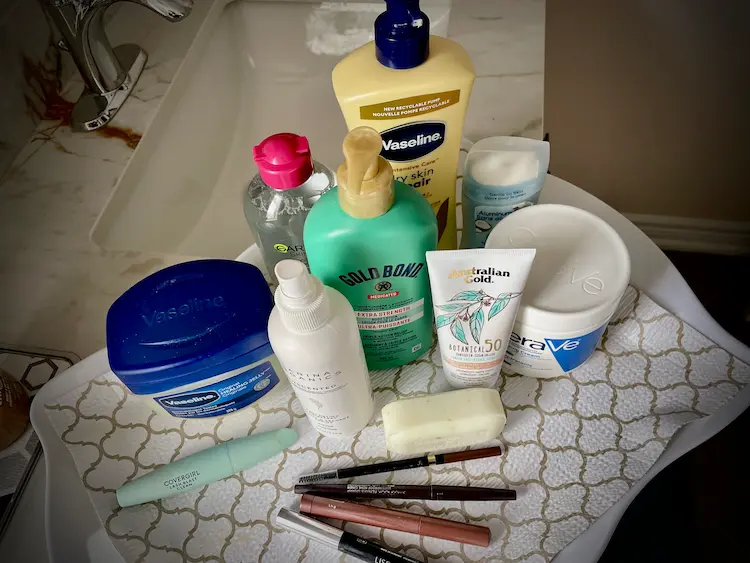
The items below are currently in my bathroom cabinet, and I’ve checked the ingredient lists for all of them. Most modern cosmetics don’t contain gluten, and when they do, it is usually clearly labeled.
Some of the links below may be affiliate links. If you purchase through them, I may receive a small commission at no extra cost to you.
|
Category |
Product |
|
Shampoo |
Inecto Naturals Intense Hydration Coconut Shampoo |
|
Hand Lotion |
Vaseline Intensive Care Dry Skin Repair |
|
Body Lotion |
Gold Bond Medicated Lotion |
|
Hairspray |
Carina Organics Unscented Fast Drying Hairspray |
|
Cleanser | |
|
Makeup Remover | |
|
Facial Moisturizer | |
|
Sunscreen / Foundation | |
|
Lip Products | |
|
Eye Makeup |
L’Oréal True Match Eye Cream in a Concealer Lise Watier Extreme Hold CC Eye Primer Lise Watier 24 HRS Glam Eyeshadow Stick Quo Beauty Eyeshadow Stick Smashbox Always Sharp Waterproof Kohl Liner |
None of the products listed above contain gluten-based on the ingredient lists available at the time of writing.
Why I Chose These Products
I’m not particularly brand-loyal. I choose products that work well for my sensitive skin and check ingredient lists for gluten.
Hair Care and Body Lotion
Shampoo
Inecto Naturals Intense Hydration Coconut Shampoo lathers up nicely and has a light coconut scent. Shampoos often make my scalp itchy, but this one leaves my hair feeling clean and my scalp itch-free.
Hand Lotion
My everyday hand lotion is Vaseline Intensive Care Dry Skin Repair. It does contain an oat extract which might concern some people. Oats are naturally gluten-free, though they can sometimes be cross-contaminated during processing. Since this product is applied topically rather than eaten, I’m comfortable using it. If this makes you uncomfortable you might choose something else.
Body Lotion
If my legs start to feel itchy in winter, I use Gold Bond Medicated Lotion, which I find very soothing.
Hairspray
Hair products are tricky for me because most irritate my scalp. The only styling product I use is Carina Organics Unscented Fast Drying Hairspray, which works well without causing irritation.
Cleanser, Moisturizer and Daily Sunscreen
Body Cleanser
In the shower I use Soap Works Cucumber & Calendula Bar Soap. It’s made by a company in Woodbridge, Ontario and uses simple ingredients.
Makeup Remover
To remove makeup I use Garnier Micellar Water, which is gentle and works well even around the eyes.
Facial Moisturizer
My daily moisturizer is CeraVe Moisturizing Cream. It was recommended by my doctor and works well for dry or sensitive skin.
Petroleum Jelly
I keep Vaseline Petroleum Jelly on hand for dry spots, around my eyes, or as a simple lip moisturizer.
Foundation / Sunscreen
Daily sunscreen is important for protecting your skin. I use Australian Gold Botanical Tinted Face Sunscreen SPF 50, which provides sun protection while giving a light natural tint.
Lip Products
People with celiac disease, myself included, often choose gluten-free lip products. This is because they can be accidentally ingested.
Instead of traditional solid lipsticks which often contain gluten, I use L’Oréal Rouge Signature Lip Stain. It lasts a long time and comes in a lightweight liquid formula with a doe-foot applicator.
For simple moisture, I use petroleum jelly at home and keep a ChapStick in my purse when I’m out.
A Quick Reminder
Cosmetic formulations can change from time to time, so it’s always wise to double-check the ingredient list.
FAQ: Gluten-Free Skin Care
Can gluten be absorbed through the skin?
Can gluten be absorbed through the skin?
No. Gluten is a protein molecule that is too large to pass through the skin barrier. Celiac reactions occur when gluten is ingested and reaches the small intestine, not from skin contact.
Do people with celiac disease need gluten-free skin care products?
Do people with celiac disease need gluten-free skin care products?
Most experts say gluten-free skin care products are not necessary for people with celiac disease because gluten cannot be absorbed through the skin. Some people still choose gluten-free cosmetics or lip products as a personal preference.
Can gluten in lipstick or lip balm cause a reaction?
Can gluten in lipstick or lip balm cause a reaction?
The risk is very small, but some experts suggest choosing gluten-free lip products because they can be accidentally ingested. For most people with celiac disease, the amount of gluten involved would likely be negligible.
Is gluten in shampoo safe for people with celiac disease?
Is gluten in shampoo safe for people with celiac disease?
Yes. Gluten cannot penetrate the skin, and shampoo is rinsed off during washing. For this reason, most dermatologists and celiac organizations consider gluten in shampoo safe for people with celiac disease.
Does makeup contain gluten?
Does makeup contain gluten?
Most cosmetics do not contain gluten ingredients. When gluten is present, it usually appears clearly on the ingredient list as wheat, barley, rye, malt, or ingredients such as hydrolyzed wheat protein.
|
|
Want simple guidance, trusted resources, and doable recipes delivered to your inbox once a week? |
|

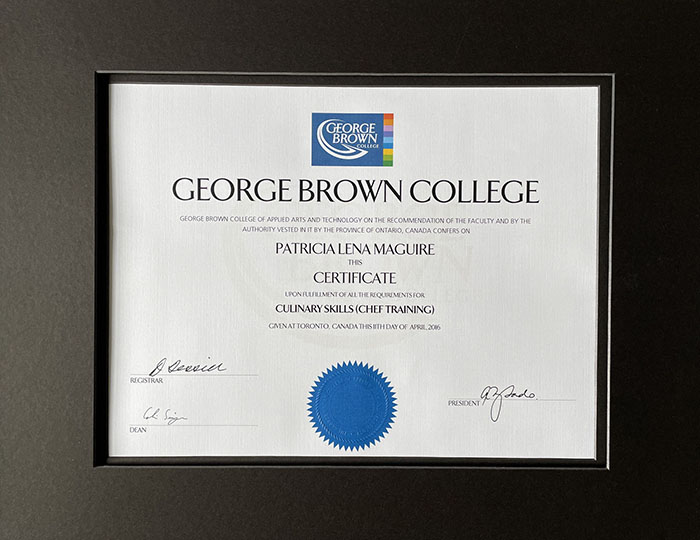
Patty Maguire is a George Brown College culinary graduate whose training focused on nutrition and cooking for special diets.
Since her celiac diagnosis in 2012, she has shared a practical, whole-food approach to naturally gluten-free living that helps readers cook with confidence, eat out safely, travel well, and live fully.
Rooted in farm-family values and simple home cooking, her work has been recognised by Feedspot’s top 10 Canadian gluten-free blogs list.
Sources
1. Bos, J. D., & Meinardi, M. M. H. M. (2000). The 500 Dalton rule for the skin penetration of chemical compounds and drugs. Experimental Dermatology, 9(3), 165–169. https://pubmed.ncbi.nlm.nih.gov/10839713/
2. Rahmani, S., Galipeau, H. J., Clarizio, A. V., Wang, X., Hann, A., Rueda, G. H., Kirtikar, U. N., Constante, M., Wulczynski, M., Su, H.-M., Burchett, R., Bramson, J. L., Pinto-Sanchez, M. I., Stefanolo, J. P., Niveloni, S., Surette, M. G., Murray, J. A., Anderson, R. P., Bercik, P., Caminero, A., Chirdo, F. G., Didar, T. F., & Verdu, E. F. (2024). Gluten-dependent activation of CD4+ T cells by MHC class II–expressing epithelium. Gastroenterology, 167(6), 1113–1128. https://pubmed.ncbi.nlm.nih.gov/39128638/
Thompson, Tricia & Grace, Thomas. (2012). Gluten in Cosmetics: Is There a Reason for Concern?. Journal of the Academy of Nutrition and Dietetics. 112. 1316-23. 10.1016/j.jand.2012.07.011.
4. Verma, A. K., Lionetti, E., Gatti, S., et al. (2019). Contribution of oral hygiene and cosmetics on contamination of a gluten-free diet: Do celiac consumers need to worry about? Journal of Pediatric Gastroenterology and Nutrition, 68(1), 26–29. https://pubmed.ncbi.nlm.nih.gov/30119098/
5. Celiac Canada. (n.d.). Gluten and lotions. Celiac Canada. https://www.celiac.ca/living-gluten-free/gluten-and-lotions/
6. Pereira, K. (2017, April 21). Gluten in makeup: Does it matter? Mayo Clinic Connect. https://connect.mayoclinic.org/blog/gastroenterology-and-gi-surgery/newsfeed-post/gluten-in-makeup-does-it-matter-2/
You might like these
10 Tips for Safe, Low-Stress Gluten-Free Family Gatherings
Feel confident at gluten-free family gatherings with 10 simple tips to stay safe, avoid hidden gluten, and enjoy meals with family and friends.
Can Apple Cider Vinegar Improve Your Life with Celiac Disease?
Want to know how to improve your digestion and help your probiotics work better? Check out apple cider vinegar and celiac disease..
Why You Shouldn't Join Gluten Free Forums or Read Blogs
Anyone can write a gluten free forum post or a blog and do so with such authority. There are a few things you need to know when you're searching for information.




Hi, I'm Patty.
I'm a person with celiac disease, a culinary school grad, and a lifelong student of food and natural healing.
After my diagnosis in 2012, I enrolled in the Chef’s School at George Brown College and earned my Culinary Skills diploma, focusing on nutrition and cooking for special diets.
Cooking has changed my life — and helped me take back my health. Now, I’m here to help you do the same.
Let’s do this together!

Subscribe!
Get Naturally Gluten-Free Digest
Practical gluten-free tips + a featured recipe/article
delivered to your inbox.
Recent Articles


-
How to Prep Ahead, Store and Reheat Gluten-Free Sheet Pan Dinners
Aug 07, 26 01:48 PM
 Learn how to prep gluten-free sheet pan dinners ahead, store leftovers safely and reheat them without drying out. Includes practical tips and a printable guide.
 -
Sheet Pan Cooking Made Easy: Get Everything to Finish at the Same Time
Jul 22, 26 04:14 PM
 Learn how to stagger sheet pan ingredients so everything finishes together. A simple method using timing windows—not complicated minute-by-minute schedules.
 -
Sheet Pan Cook Time Chart for Proteins and Vegetables
Jul 22, 26 04:13 PM
 Compare sheet pan cook times for proteins and vegetables, timing windows and safe internal temperatures. Includes a printable cook time chart.


Popular Articles



Trained in Culinary Skills with a focus on Nutrition and Healthy Eating!
Visit NGF (NaturallyGluten-Free) on Facebook at: https://www.facebook.com/naturallyglutenfree
On Substack at: Naturally Gluten-Free Digest
Patricia Maguire, copyright © 2026 naturallygluten-free.com Port Hope, Ontario, Canada. All rights reserved
Subscribe to
Naturally Gluten-Free Digest
- Feel safer and more confident eating gluten-free
- Save time and money with practical strategies
- Discover trustworthy recipes and resources without wading through misinformation
It's Free!
You won't have to remember to check back.
NGF will land in your inbox weekly.
and
As a thank-you from me you get a free
Printable Gluten-Free Food List
that you can pin to your fridge or take shopping.
I respect your privacy!
I won't use your email for anything but to send you the newsletter.